My father was Richard Packer. A poet and playwright. He published at least four poetry books both in Australia and New Zealand and was passionate about his work. He died at the age of fifty -three in a tiny little flat in Toorak Melbourne. I had not seen my father since I was thirteen. My memories of him are quite faded now but I do remember that he used to sing sea shanties to me and my two brothers. He took me to the zoo once where I got bitten by a pelican and he turned up for a parents day at my primary school looking like a beatnik ( Hippy Dude ) in a daggy old jumper and jeans. All the other dads wore suits and I was mortified. He was given to rages due to alcohol and drugs and loved Indian sitar music. He also worked in advertising so you could say he was one of the original ‘Mad Men’ just like in the series. My dad travelled extensively and never cease to question the world and the role of man and womankind in it. Here then is one of his poems from ‘Prince Of The Plague Country’ written published in 1964.
While in the process of writing ‘ The Past Tense Of Youth’ I spent hours searching through the European Orientalist painters at the turn of the century and also great artworks of the 1930s.
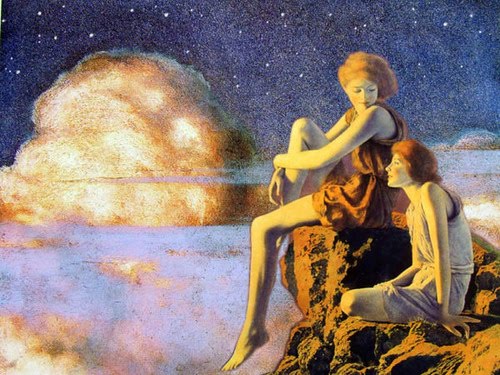
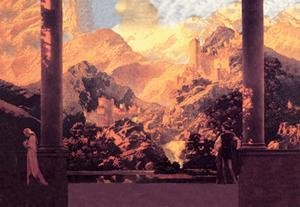
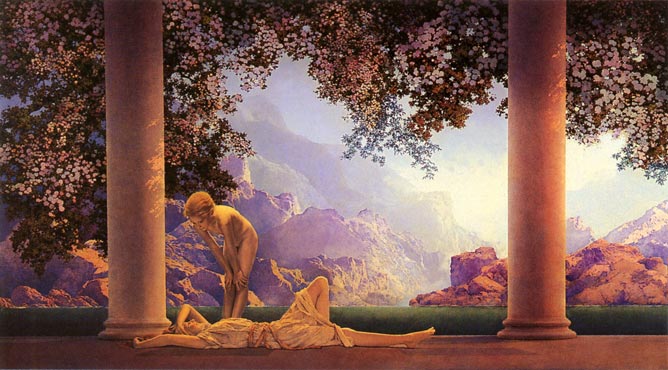
Amongst others from the latter period I came across the works of Maxfield Parrish whose amazing Florescent colours really made his work stand out. An American artist who was famous for his childrens illustrations as much as for his paintings Parrish lived his whole life in New Hampshire and his home, also his studio, was called ‘The Oaks’.
‘Daybreak’ Maxfield Parrish
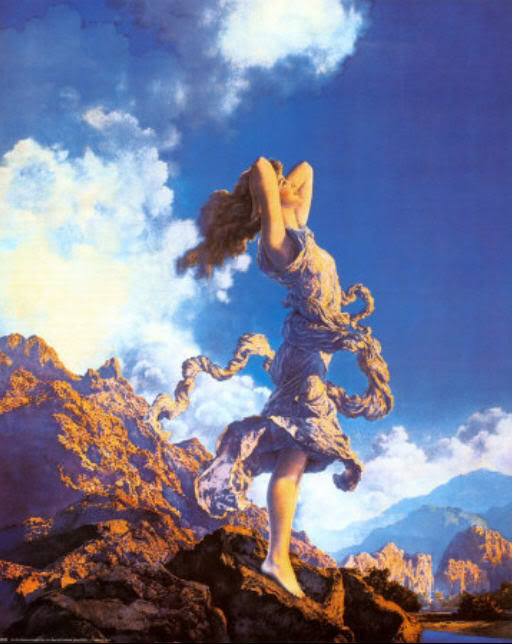
A beautiful dreamlike quality permeated his work and gave it a fairytale quality. In his paintings there is also a strong emphasis on photography and it is at times like looking at an over exposed negative particularly in ‘The Garden of Allah’ A very 1930s deco depiction of the east. Soft,romantic and contemplative with the beauty of the gardens creating a fantasy backdrop.
Parrish ” Mountain Ecstacy’
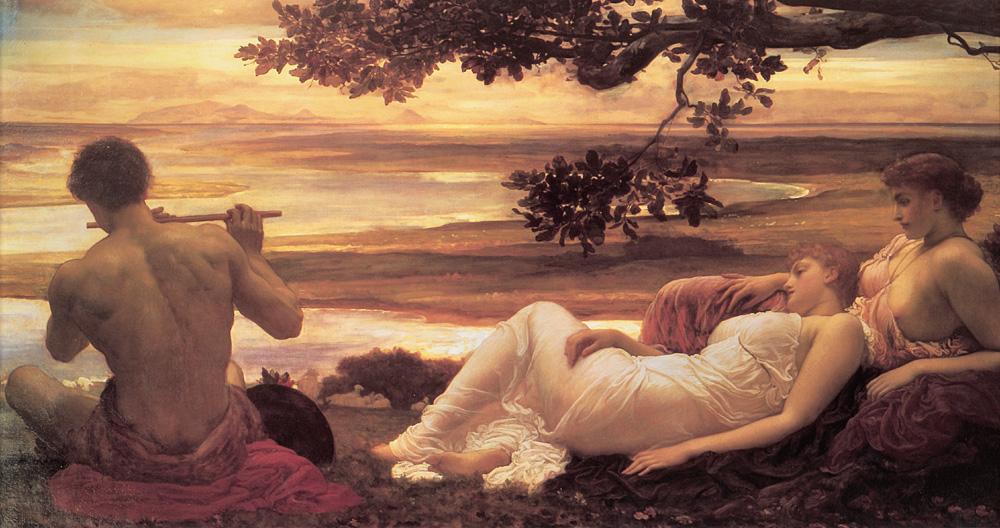
There was a certain similarity too between the art of Maxfield Parrish and that of some of my favourite Orientalists principally in the use of light. Especially the works of Lord Leighton . The visual splendour of paintings by both these arists have inspired my writing and have helped to move my story which begins in the 1930s and goes back to the early 19th century.
Frederick Leighton was, of course, known as one of the greatest classical painters of his time and his work was known throughout Europe.
Born in England Leighton came from a very wealthy family and travelled Europe extensively. He fell under the spell of the east, however, spending a great deal of time in North Africa in particular.
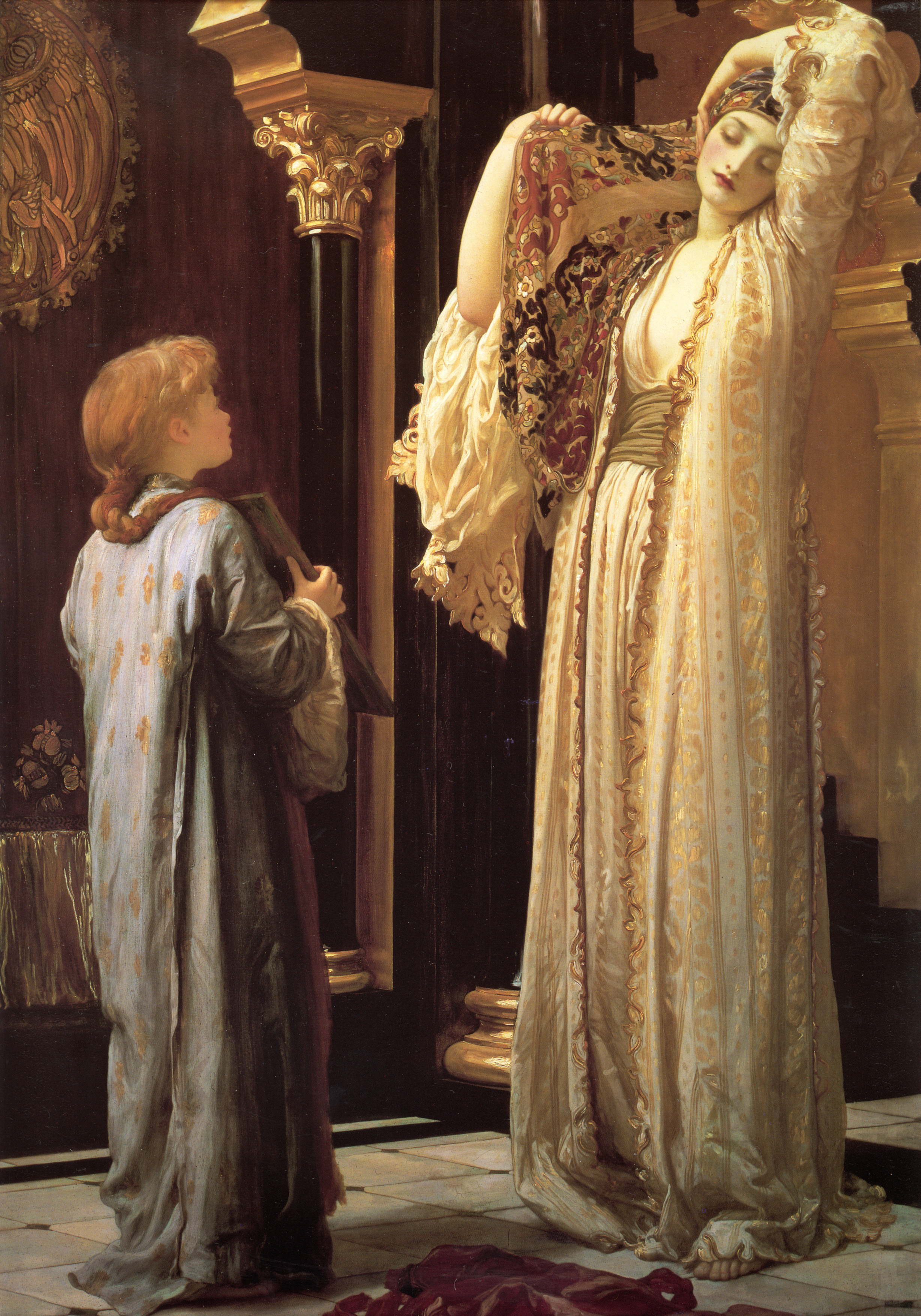
It is well known that he questioned his own religion and his wok reflected a humanist approach full of mystic romanticism.He was enamoured with mythology and with nature. In ‘Light Of The Harem’ seen her in the centre Leighton paints a very romanticised picture of life in a harem. The beauty on the right seems off in a daydream while her young servant girl holds up a mirror to her face. All around her there is a soft golden light that gives her an inner glow.
‘Solitude’ Frederick Leighton
As in the paintings of Maxwell Parrish there is an inner peace and a contemplative quality that evokes the imagery of an ideal world.
Although these two great artists were from different eras and different countries they shared a similarity in the way they viewed their respective worlds.
The beauty of these great works of art fuels the imagination and feeds the senses.
Born in England and educated in France Virginia Field began her Hollywood film career during the 1930s and her very first big budget film was for David O.Selznick the man who would later go on to produce ‘Gone With The Wind’. The film was ‘Little Lord Fontleroy ” Although she only really had a minor role in the film as the beautiful actress’ Miss Herbert’ she was certainly noticed. She was signed to play various roles in the ‘Mr Moto’ detective series and her versatility put her firmly in the role of character actress. For most of her work in Hollywood Field played supporting roles and was mostly cast as the other woman or friend of the leading actress. Films included ‘ Captain Fury,’The Perfect Marriage’ and ‘Dream Girl’ to name a few. She was rarely given top billing even though her talents deserved it. As an actress she had a loyal trust worthy quality which showed in the quiet inner strength portrayed by her characters. This quality was most notable in ‘Waterloo Bridge’ with Vivienne Leigh and Robert Taylor in which she is both friend and confidante to Leigh’s fragile young ingenue. Probably one of her most memorable film roles other than ‘Waterloo Bridge’ was one with a very ambitious plot line involving time travel and the chance to go back and fix mistakes. The film ‘Repeat Performance ‘starring Louis Hayward and Joan Leslie centres on a woman who kills her husband on New Years Eve wishing she could turn back the clock so that the murder never took place. Her wish is granted and she is able to go back in time and repeat the events leading up to the shooting. The film stops short at the exact moment and the audience are left with the question of …. Will she or won’t she do it again? Field married three times and went on to play support characters for many years to come including pppearing in the Perry Mason series during the 1960s. Apparently Virginia Filed was someone who liked to tell it like it is and dished the dirt on some of her co – stars. Maybe this is the reason she was never able to make it to the top. No room for truth in Hollywood eh!









 Bourgeoise Bloomers