

Review For Potential Films
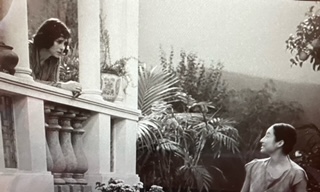
Directed by Miguel Gomes, the Portuguese film, Grand Tour, is really a philosophical, contemplative, slow and brooding exploration of shadow and light. There is a very minimal story and more questions than answers as the the main character, Edward Abbott, moves from Singapore to Bangkok, Saigon, Japan and China, trying to escape his fiancé of seven years. Why? We don’t know. Not only that, we don’t know who Edward is and we don’t know what he does for a living or why he waited seven years to leave his fiancé.
When Edward reaches Raffles in Singapore and bumps into Reginald, a relative of his fiancé, it looks like some of our questions might be answered. Is he actually a spy? What is the telegram he receives and why is he being measured by a tailor for a new suit? Before Reginald can ask him these same questions, Edward is on a train to Bangkok. The train crashes. Edward calmly sits by the railway track, smokes his pipe and sketches the surrounding jungle whilst waiting for another train. Is he a well known artist? We don’t know.
From here we are treated to traffic scenes in the streets of Bangkok. The locals on motorbikes wear masks. This is followed by a scene in the palace with the prince and dancers waltzing in a ballroom to music by Strauss before Edward hops on a fishing boat and ends up in Saigon.
Eventually he reaches Japan on an American warship and finds himself on the streets of Kyoto with men who wear baskets over their heads. They take him to the temple where he has a meditation session with a holy man. They talk of shadows. The holy man reveals the nature of the Japanese by explaining that they do not hide from shadows. They look for them.
When Edward leaves Japan for China, the second half of the film concentrates on Molly, Edward’s fiancé. We follow Molly as she travels first to Singapore and then on to all the locations Edward has been. Her search for her escaped fiancé is a little desperate until a new world and a new way of viewing life is revealed to her through new sounds, traditions, life on the streets and finally in the jungle. Why is she so determined to find him when it seems he is so determined not to be found?
Through the music of gamelan, Karaoke, Classical composers, birdsong, traffic noise and crickets, Grand Tour, is quite a cacophony of sounds. Along with shadow puppets and carousels and life on a fishing boats and villagers plucking chickens in local markets, it is also a visual pallet of real life in real time, filmed mostly in black and white. This film manages to take us somewhere but really ends up nowhere. On the whole, it is by no means a linear film and is more suited to the avante-garde art connoisseur than the average audience.
 Bourgeoise Bloomers